
Why Databricks
Why we exclusively build on Databricks
Many organizations start with a separate solution for each data need: a database for reporting, a tool for ETL processes, a dashboard environment, and later maybe an AI platform. On its own, that works fine. But over time, it often turns into a landscape of separate systems that all need to communicate with each other. That costs time, makes management more complex, and adds extra licensing and maintenance costs.
That’s why we build exclusively on Databricks. Not because it’s a popular technology, but because it brings data, analytics, and AI together in one environment. That creates a foundation that stays manageable and can grow alongside your organization’s needs.
When a data landscape gets too complex
Many companies recognize one or more of these situations:
- Data is scattered across different systems.
- New integrations take more time than expected.
- Reporting depends on manual work.
- AI projects struggle to get off the ground.
- Managing tools and licenses keeps growing.
Databricks helps reduce that complexity by bringing storage, data processing, analytics, and AI together on one platform.
| Traditional approach | With Databricks |
|---|---|
| Disconnected tools: Separate systems for storage, ETL, and machine learning create constant points of failure. | One unified environment: Storage, transformation, analysis, and AI run smoothly within the same ecosystem. |
| Vendor lock-in: Closed systems keep you trapped, driving up migration costs, and eliminating flexibility. | Cloud-agnostic design: The platform runs flexibly on AWS, Azure, and Google Cloud. You're never stuck. |
| Slow innovation: Older platforms weren't built for AI. Adding intelligence often means starting from scratch. | Built for intelligence: AI isn't a bolted-on feature, it's the foundation. Clean data today, AI in production tomorrow. |
What can you do with Databricks?
Store and manage data centrally. Keep data in one place and manage access rights centrally, so you always know who has access to which information.
Automate data flows. Process new data automatically and keep datasets current without unnecessary manual work.
Build reports and analyses. Create dashboards and analyses from the same environment where the data is processed.
Develop AI solutions. From machine learning to generative AI, develop, test, and deploy models without moving data between different systems.
A platform that grows with your organization
An organization’s needs change. Maybe you start with reporting and dashboards, but later want to build predictions or apply AI to business processes. With Databricks, you don’t have to redesign your architecture every time your needs change, whether that means supporting a handful of small data projects or a large-scale data and AI environment. Usage-based pricing means the platform stays affordable while you’re small and scales with you as you grow, without a separate re-architecture project along the way.
Trusted at scale
That scalability is also why some of the largest, most demanding organizations run on Databricks: global banks, logistics giants, and healthcare providers all rely on it for critical processes where downtime or data loss isn’t an option. If the platform holds up under that kind of load, it’s a reasonable bet it will hold up under yours too.
It also does that without locking you in. Databricks runs on the cloud of your choice, AWS, Azure, or GCP, so you stay in control of that decision rather than being stuck with whichever cloud you happened to pick first. That keeps the platform a flexible business asset instead of another constraint to work around.
How we help
As a Databricks partner, we support organizations at every stage of their data and AI journey.

Databricks Training
Practical training that gets your team working independently with Databricks.
Databricks AI Engineering
From experiment to production: we help develop and implement reliable AI solutions.
Databricks Geospatial Consultancy
Get more value out of location data for analyses, reporting, and AI applications.
Managed Databricks
We manage the platform, so your team can focus on the business instead of the infrastructure.
Databricks Consultancy
Need extra expertise for a project or a specific challenge? Our consultants help with design, implementation, and optimization.
Architecture Review
We analyze your current data environment and map out improvement areas, risks, and opportunities.
Why organizations work with RevoData
Gold Partner
We're experienced Databricks specialists in engineering, data science, machine learning, and business analytics. Our proven client success and certified expertise have earned us recognition as a Databricks Gold Partner.
Databricks Champions
We have one of the highest numbers of Databricks Champions in EMEA, a strong mark of recognition from Databricks. This exclusive title proves our team's practical expertise and commitment to excellence.
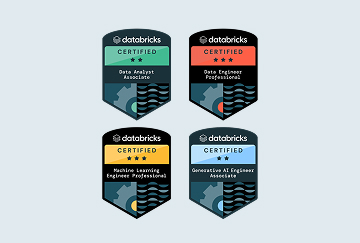
100% Certified
100% of RevoData's consultants are Databricks-certified in their areas of expertise. Many hold multiple certifications and badges, reflecting our strong commitment to continuous development.
Ready to transform your data foundation?
Want to find out how Databricks can speed up your data projects and lower your licensing costs? Together, we’ll map out how to replace your fragmented systems with one powerful, unified platform that’s ready for the future. Schedule a no-obligation conversation with Thijs!
Frequently asked questions about Databricks
Databricks brings data storage, data processing, analytics, and AI together on one platform. That means fewer separate systems are needed, and it becomes easier to make data available across different teams.
No. Databricks is a data and AI platform that uses cloud storage. It combines the advantages of a data lake with functionality you’d normally expect from a database, such as fast queries and reliable transactions.
Yes. While Databricks is widely used by large enterprises, it’s also well-suited to mid-sized organizations. You can start small with reporting and data processing and later expand into advanced analytics and AI applications.
Databricks makes sense when your organization works with growing volumes of data, uses multiple data sources, or plans to apply AI and machine learning. Organizations looking to simplify their current data landscape also often choose Databricks.